Problem
Veterans returning to civilian life face a fragmented landscape of support resources scattered across government agencies, nonprofits, and local organizations. Finding verified, relevant help for housing, benefits, healthcare, or crisis support often takes weeks of research. Many veterans give up before finding what they need.
The VA website alone has thousands of pages. State and local resources are even harder to navigate. For a veteran in crisis, “just Google it” isn’t good enough.
Why this matters
This is personal. The veteran community deserves better than outdated government portals and endless searches during some of the hardest transitions of their lives. Vet Uplift exists to make the first step, finding the right help, as fast and simple as possible.
Constraints
- Resources must be verified and current. Outdated links erode trust fast
- The interface must be accessible to veterans of all ages and technical comfort levels
- Must support multiple resource categories: housing, financial/benefits, healthcare, mental health, employment, legal, and family/caregiver support
- Zero friction to start. No signup required to find resources
- Crisis resources must be immediately visible, not buried in navigation
Tech Stack
- Next.js + React for the frontend. Server-side rendering means fast initial loads, which matters when someone might be accessing the site on a slow phone connection.
- TypeScript for reliability. When people depend on this tool during difficult moments, runtime errors are unacceptable. Type safety catches issues before deployment.
- Supabase for auth and database management. The admin interface for managing resources uses Supabase auth. Real-time subscriptions update the resource directory without page refreshes as new resources are verified.
- PostgreSQL for structured resource data. Each resource is stored with category tags, verification status, geographic scope, contact information, and eligibility criteria. Relational modeling handles the many-to-many relationship between resources and categories cleanly.
- Tailwind CSS for clean, accessible styling. High contrast, large touch targets, readable typography. The design prioritizes clarity over visual complexity.
- Vercel for hosting. Edge deployment means fast loads regardless of where the veteran is located. Zero-downtime deployments keep the site available 24/7.
Approach
Built a guided experience that asks one question: “What do you need help with most right now?” From there, veterans are matched with verified resources in their category. The design prioritizes clarity and speed over feature density.
The data layer uses structured resource entries with category tagging, verification status, and geographic relevance. Supabase handles the backend with PostgreSQL for reliable data storage and real-time updates as resources are verified and added.
Key decisions
- Guided flow over search. Veterans in crisis don’t want to type queries. A step-by-step flow reduces cognitive load and gets to resources faster.
- No signup wall. Trust is earned, not gated. Anyone can find resources without creating an account.
- Verification-first data model. Every resource has a verification status. Unverified entries are flagged, not shown. Better to show fewer resources than to show broken links.
- Category-based architecture. Resources are organized by need, not by provider, because veterans think in terms of problems, not organizations.
- Crisis resources above the fold. The Veterans Crisis Line and immediate support options are always visible, never more than one click away.
Outcome
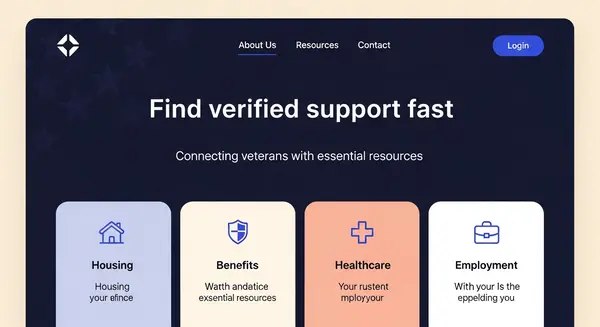
Vet Uplift is live at vetuplift.com, serving veterans with a clean, fast path to verified support resources across seven major categories. The guided flow gets users from landing page to relevant resources in under 30 seconds.
Lessons learned
- Accessibility is not optional. Building for veterans of all ages and abilities meant taking WCAG guidelines seriously from day one. High contrast, keyboard navigation, screen reader support. These aren’t nice-to-haves for this audience.
- Less is more when trust matters. Early versions had more features: user accounts, saved resources, community forums. Stripping it down to the core, find the right resource fast, made the product better. Features that slow down the critical path don’t belong in v1.
- Content is the product. The technology is a delivery mechanism. The real value is curated, verified resource data. No amount of engineering polish compensates for outdated or incorrect resource information.